
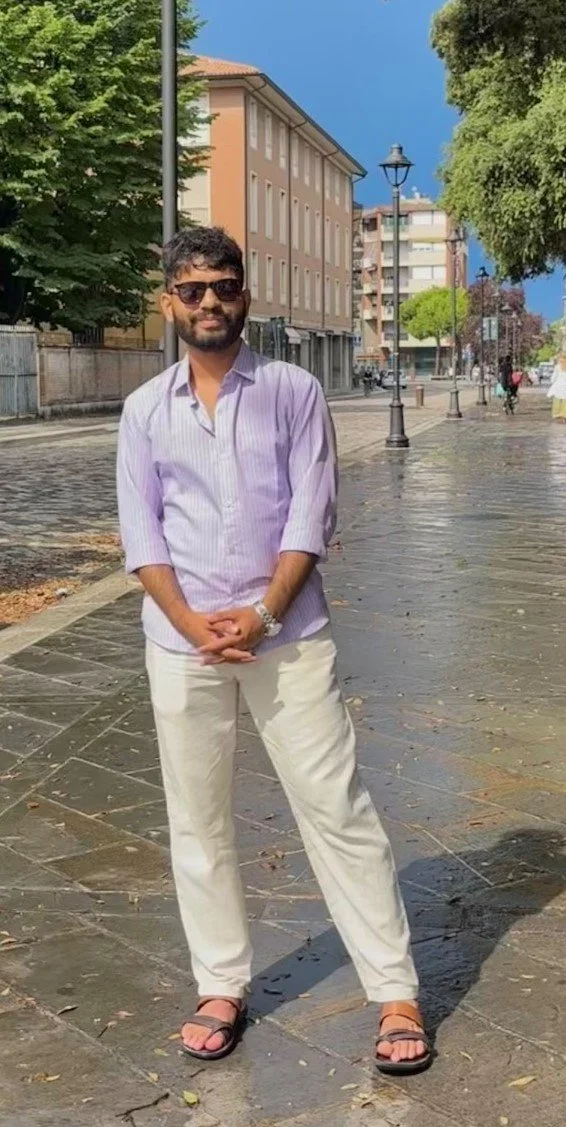
DC12
AI-based multi-color ciliary image analysis upon expansion microscopy (WP2)
Supervisor: Dr. Florian Jug
Host Institute: Human Technopole Milan, Italy
Secondments: Radboud University Medical Center Nijmegen, The Netherlands; University of Copenhagen, Denmark
Doctoral Program: Humanitas University
Aman Kukde holds a dual degree in Biomedical Engineering from the Indian Institute of Technology, Varanasi and brings nearly one year of industry experience as a DataScientist. His research interests include generative models, uncertainty estimation, and their applications to high-dimensional biomedical imaging data.
Under this project his work will aim to advance AI-based methods for better processing and interpretation of ciliary microscopy data.
AI for Cilia Research: Uncertainty, Calibration, and Multimodal Representation Learning
Uncertainty & Calibration: This project aims to develop AI models that not only generate pointpredictions for analysis problems of other members of this consortium but also provide reliable estimates of their own uncertainty. It will integrate methods for quantifying both epistemic (model) and aleatoric (data) uncertainty and apply modern calibration techniques to ensure statistically trustworthy outputs. The robustness of these approaches will be evaluated across datasets originating from different laboratories, imaging conditions, and biological contexts. Ultimately, the project will demonstrate how uncertainty-aware and well-calibrated AI models can support phenotype classification and ciliopathy-related prediction tasks in a reliable and interpretable manner.
Multimodal / Generative AI: If suitable data arises, this project will work on generative AI models that learn a shared latent space that unifies microscopy imaging data, molecular/omics measurements, and/or phenotypic labels. Multiple representation-learning strategies, such as variational autoencoders, contrastive and triplet-loss approaches, and diffusion/score-based generative models, will be explored to ensure that the latent space captures biologically meaningful structure. Such unified representations will then be useful for diverse tasks, e.g. to uncover morphological and disease-associated patterns, perform cross-modal predictions, and enable generative exploration of cellular states – all of which will formulate biological hypotheses that aid cilia scientists to better interpret and utilize their data.